
Being a mom often means starting the day with a long list of responsibilities already running through your mind. Before you have even finished your morning coffee, you may be thinking about breakfast, school bags, laundry, appointments, work deadlines, grocery shopping, dinner, and everything else your family needs.
When every day feels full, it is easy to believe that you need a perfect schedule, an organised home, or several uninterrupted hours to feel calm finally. In reality, most busy moms do not need a complicated productivity system. They need a simple daily routine that provides structure without creating more pressure.
A calm routine is not about controlling every minute of the day. It is about creating a few dependable moments that help you pause, reset, and decide what matters most. When you know what to do first, what to wait on, and how to recover when plans change, daily life becomes more manageable.
The following routine is designed for real motherhood. It allows for interruptions, tired mornings, unpredictable children, work responsibilities, and days when nothing goes according to plan. You can adjust it to your family’s needs while keeping the basic structure intact.
Why Busy Moms Often Feel Mentally Overloaded
Mothers frequently carry responsibilities that other people cannot see. Along with completing physical tasks, they often remember birthdays, plan meals, check school messages, replace household supplies, arrange appointments, and anticipate what each family member may need next.
This ongoing mental work is sometimes called the mental load. It can make you feel tired even when you have not completed many visible tasks. Your mind remains active because it is constantly tracking unfinished responsibilities.
A lack of routine can increase this pressure. When there is no clear structure, you may repeatedly ask yourself:
- What should I do next?
- Am I forgetting something important?
- Should I clean, work, cook, or rest?
- Why does the house become messy so quickly?
- How will I finish everything before bedtime?
- Why do I feel behind even after being busy all day?
These decisions consume mental energy. A simple routine reduces the number of choices you have to make. It gives your day a predictable rhythm and helps you focus on one stage at a time.
The Goal Is Rhythm, Not Perfection
A useful daily routine should support your life, not control it. Some days, you may follow the routine closely. On other days, a sick child, an unexpected phone call, a school event, or a difficult work assignment may change everything.
That does not mean the routine has failed.
A healthy routine is flexible enough to survive real life. Instead of depending on exact times, it can be organised around natural parts of the day, such as waking up, leaving the house, lunchtime, late afternoon, and bedtime.

Think of the routine as a series of anchors. Each anchor allows you to reconnect with your priorities and begin again.
The most helpful mindset is:
- Do what matters most.
- Keep the routine simple.
- Expect interruptions.
- Reset instead of giving up.
- Leave space for rest.
- Adjust the plan when your family’s needs change.
A Simple Daily Routine for Busy Moms
The routine below includes five main stages:
- A quiet morning start
- A focused planning period
- A midday reset
- An afternoon home transition
- A calming evening close
You do not need to complete every step perfectly. Even using two or three parts consistently can make your days feel more organised.
| Part of the Day | Main Focus | Suggested Time | Desired Result |
|---|---|---|---|
| Early morning | Personal reset and preparation | 10–20 minutes | Begin the day calmly |
| Morning | Priorities and essential tasks | 5–10 minutes | Know what matters most |
| Midday | Mental and physical reset | 10–15 minutes | Prevent afternoon overwhelm |
| Late afternoon | Home and family transition | 15–30 minutes | Reduce evening chaos |
| Evening | Preparation and rest | 20–30 minutes | End the day with closure |
Step 1: Begin With a Quiet Morning Reset
The way you begin your morning can affect the emotional tone of the entire day. This does not mean you need to wake up at 5:00 a.m., complete an intense workout, prepare a perfect breakfast, and organise the whole house before anyone else wakes up.
For most busy moms, that type of morning routine is unrealistic.
Instead, aim for a short period of quiet before the day becomes demanding. Even ten minutes can help you feel more grounded. You may use this time before your children wake up, after your spouse leaves for work, or while the house is still relatively peaceful.
Your morning reset might include:
- Drinking a glass of water
- Opening the curtains
- Sitting quietly for a few minutes
- Saying a prayer
- Practising deep breathing
- Reading a short devotional
- Stretching your body
- Writing one sentence in a journal
- Avoiding social media for the first few minutes
The goal is not productivity. The goal is to meet before you begin meeting everyone else’s needs.
If your children wake up early, do not assume that a calm morning is impossible. You can still create a brief reset while they eat breakfast, watch a short programme, or play nearby. Calm does not always require silence. It requires intention.
Try the Three-Breath Pause
Before checking messages or starting household tasks, take three slow breaths.
As you inhale, relax your shoulders. As you exhale, release the pressure to complete everything perfectly.
Then remind yourself:
I do not have to solve the whole day right now. I only need to begin with the next important step.
This small practice can interrupt anxious thinking and help you approach the morning with greater clarity.
Step 2: Choose Three Priorities for the Day
Long to-do lists often make busy moms feel more overwhelmed rather than more organised. A list containing twenty tasks may look productive, but it can create the impression that every item is equally urgent.
Instead, choose three main priorities.
These priorities should represent the most important areas of your day. A helpful structure is:
- One priority for your family or home
- One priority for work or personal responsibilities
- One priority for your own wellbeing
For example:
- Family or home: Prepare dinner before the school pickup.
- Work or responsibilities: Complete and send the client report.
- Personal wellbeing: Take a twenty-minute walk.
Your priorities will change from day to day. On a busy appointment day, your main goal may simply be getting everyone where they need to go. On a quieter day, you may focus on cleaning, meal preparation, or completing an important project.
The purpose of choosing three priorities is to define what a successful day looks like. If you complete these three items, you can recognise that you made meaningful progress even if the laundry remains unfolded.
Use a “Must, Should, Could” List
Another practical approach is to divide tasks into three categories.
Must do
These tasks have a deadline or immediate consequence.
Examples include:
- Attend a medical appointment
- Pay a bill due today
- Submit a work assignment
- Collect a child from school
- Buy food needed for dinner
Should do
These tasks are important but can be moved if necessary.
Examples include:
- Wash a load of laundry
- Reply to non-urgent emails
- Clean the bathroom
- Plan meals for the week
- Organise school paperwork
Could do
These tasks are optional improvements.

Examples include:
- Rearrange a cupboard
- Try a new recipe
- Organise family photographs
- Deep-clean the refrigerator
- Update home decorations
This method helps you stop treating optional tasks like emergencies.
Step 3: Complete a Ten-Minute Morning Home Reset
A full-house cleaning session is rarely possible during a busy morning. However, a ten-minute reset can prevent small messes from becoming overwhelming later.
Set a timer and focus only on the areas that affect the flow of your day.
You might:
- Put breakfast dishes in the dishwasher
- Wipe the kitchen counters
- Place dirty clothes in the laundry basket
- Return shoes and bags to their proper places
- Start one load of laundry
- Throw away visible rubbish
- Make the main bed
- Clear the dining table
- Collect items that belong in another room
Do not use this time for deep cleaning. You are not trying to make the house perfect. You are creating enough order to help your home function.
When the timer ends, stop. This boundary is important because household tasks can expand and consume the time intended for work, rest, or family.
Focus on Visual Calm
Some areas have a greater effect on how organised your home feels. Clearing these spaces can quickly create visual calm:
- The kitchen counter
- The dining table
- The entryway
- The living-room sofa
- The bathroom sink
- The floor near the front door
You do not need to organise every cupboard. Start with what you can see and what your family uses most often.
Step 4: Work in Focused Blocks
Busy moms are often interrupted. Trying to concentrate for several uninterrupted hours may not be realistic, especially when caring for young children or managing household responsibilities.
Focused work blocks provide a more flexible solution.
Choose one task and work on it for twenty-five to forty-five minutes. During that time, avoid switching between email, social media, cleaning, and unrelated projects.
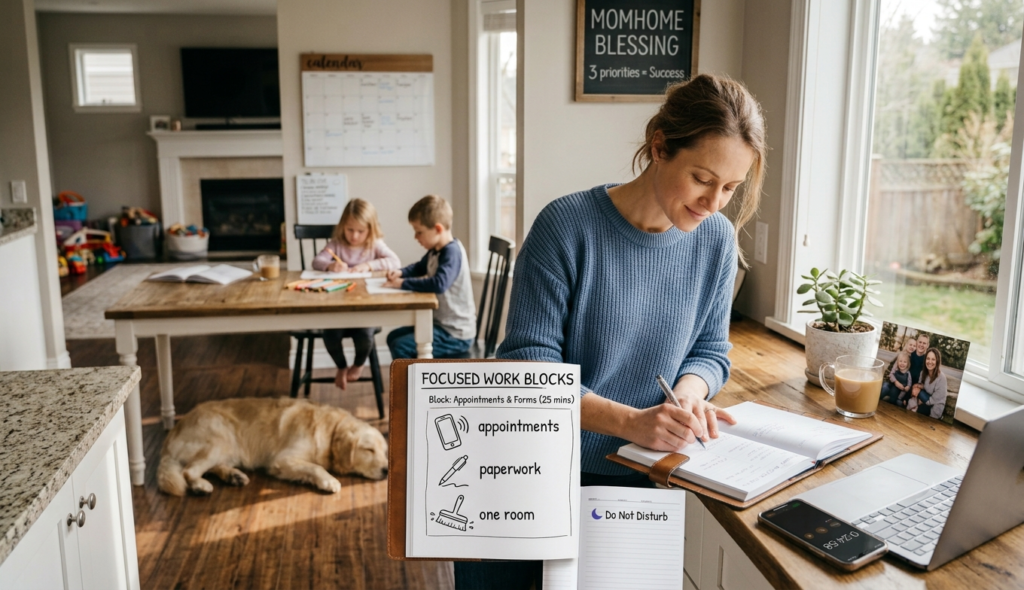
A focus block can be used for:
- Paid work
- Household administration
- Meal preparation
- Studying
- Cleaning one room
- Organising paperwork
- Planning family activities
- Completing an online form
- Making appointments
- Working on a personal goal
After the block, take a short break. Stand up, drink water, check on your children, or move to the next part of your routine.
Keep a Distraction List
When unrelated thoughts appear during a focus block, write them down instead of immediately acting on them.
For example:
- Order school shoes
- Reply to Sarah
- Check the electricity bill
- Add milk to the shopping list
- Book a dentist appointment
Keeping a distraction list reassures your brain that the thought will not be forgotten. You can review the list later without interrupting your current task.
Step 5: Create a Midday Reset
The middle of the day is a common point for stress to increase. Morning energy begins to fade, unfinished tasks become more noticeable, and the afternoon may already feel crowded.
A midday reset helps you pause before pressure builds.
Your reset does not need to be long. Ten to fifteen minutes is enough.
Use this time to:
- Drink water
- Eat something nourishing
- Step outside
- Stretch
- Clear one small surface
- Review your three priorities
- Move unfinished tasks to another day
- Take five slow breaths
- Sit without looking at your phone
- Check what your family needs for the afternoon
Ask yourself three questions:
- What have I already completed?
- What still matters today?
- What can I release or postpone?
These questions prevent you from measuring the day only by what remains unfinished.
Protect Your Energy After Lunch
Many people experience lower energy in the early afternoon. Instead of expecting yourself to perform at maximum capacity throughout the entire day, match tasks to your energy level.
Use higher-energy periods for:
- Difficult work
- Important decisions
- Exercise
- Detailed planning
- Tasks requiring concentration
Use lower-energy periods for:
- Folding laundry
- Replying to simple messages
- Preparing ingredients
- Tidying a room
- Listening to educational content
- Completing routine household tasks
Working with your energy is often more effective than forcing yourself to follow an unrealistic schedule.
Step 6: Prepare for the Late-Afternoon Transition
The period between school pickup and dinner can be one of the busiest parts of the day. Children may be hungry, tired, noisy, or in need of attention. At the same time, you may be trying to finish work, prepare food, check homework, and manage the house.
A short transition routine can reduce this pressure.
Before the busiest part of the afternoon begins, try to complete a few basic preparations:
- Decide what the family will eat
- Take frozen food out in advance
- Clear the kitchen workspace
- Refill your water bottle
- Prepare a simple snack for the children
- Check school bags or messages
- Put important evening items in one place
- Choose one small household task to complete
- Stop non-essential work at a defined time
The purpose is to remove unnecessary decisions from the evening.
Create a Family Landing Zone
Choose one area near the entrance for frequently used items. It may include:
- School bags
- Shoes
- Coats
- Keys
- Lunch boxes
- Water bottles
- Sports equipment
- Items that need to be returned
A family landing zone reduces the daily search for missing belongings. It also makes the home easier to reset at night.
Step 7: Simplify Dinner Expectations
Dinner does not need to be elaborate every night. A simple, balanced meal is enough.
Create a short list of reliable meals your family accepts. These may include:
- Pasta with vegetables and protein
- Rice with chicken or beans
- Soup with bread
- Baked potatoes with toppings
- Sandwiches with fruit and yoghurt
- Omelettes with toast
- Tacos or wraps
- A slow-cooker meal
- Leftovers from the previous evening
- A simple freezer meal
You can also assign general meal types to different days:
| Day | Meal Theme | Example |
|---|---|---|
| Monday | Pasta night | Pasta with tomato sauce and vegetables |
| Tuesday | Tacos or wraps | Chicken wraps with salad |
| Wednesday | Slow-cooker meal | Soup, stew, or curry |
| Thursday | Leftover night | Reheated meals with a fresh side |
| Friday | Family favourite | Homemade pizza or burgers |
| Saturday | Flexible meal | Eating out or trying a new recipe |
| Sunday | Comfort meal | Roast, casserole, or family recipe |
Meal themes reduce decision fatigue while still allowing variety.
Step 8: Use a Fifteen-Minute Evening Tidy
After dinner, the idea of cleaning the entire house may feel exhausting. Instead, involve the family in a fifteen-minute reset.
Set a timer and give everyone an age-appropriate task.
Children may:
- Put toys away
- Carry clothes to their rooms
- Place shoes near the door
- Wipe the table
- Pack school bags
- Put books back on shelves
- Place dirty dishes near the sink
Adults may:
- Load the dishwasher
- Wipe counters
- Prepare the coffee or tea area
- Check the next day’s calendar
- Take out rubbish
- Start the dishwasher
- Fold blankets
- Put away items from the living room
The aim is not to finish every chore. The aim is to make tomorrow morning easier.
A fifteen-minute family reset can accomplish more than one tired parent cleaning alone for an hour.
Step 9: Prepare Tomorrow Before Bed
A calm morning often begins the night before. Spending ten minutes preparing for tomorrow can prevent stress, forgotten items, and rushed decisions.
Before bed, check:
- Clothes for the next day
- School bags and homework
- Lunches or snacks
- Work materials
- Appointments
- Transport arrangements
- Weather-related items
- Forms that require signatures
- Medication or health needs
- Dinner ingredients
You may also write tomorrow’s top three priorities. This allows your mind to release the responsibility of remembering everything during the night.
Use a Simple Evening Checklist
Your checklist might include:
- Kitchen closed
- Bags ready
- Clothes selected
- Calendar checked
- Alarm set
- Phone charging
- One surface cleared
- Tomorrow’s priorities written
Keep the checklist short. A routine becomes sustainable when it is easy to repeat.
Step 10: Close the Day Without Judging Yourself
Many mothers end the day reviewing everything they did not finish. This habit can create guilt and make it difficult to rest.
Instead, practise a brief daily closure.
Ask yourself:
- What went well today?
- What did I handle better than I realised?
- What can wait until tomorrow?
- What support do I need?
- What am I grateful for tonight?
You do not need to pretend that every day was wonderful. Some days are genuinely difficult. The purpose of reflection is to recognise effort, learn from the day, and create emotional closure.
Try replacing “I did not do enough” with a more accurate statement:
- I handled what I could with the energy I had.
- I cared for my family in meaningful ways.
- I made progress, even if everything was not completed.
- Rest is part of being responsible.
- Tomorrow gives me another opportunity to begin.
What to Do When the Routine Falls Apart
Every routine will eventually be interrupted. Children become ill. Work emergencies happen. Sleep is lost. Plans change.
When this happens, return to a minimum version of the routine.
Your minimum routine may be:
- Drink water
- Choose one essential priority
- Feed yourself and your family
- Complete a ten-minute tidy
- Prepare one thing for tomorrow
- Go to bed as early as reasonably possible
This is enough for a difficult day.
Avoid trying to “catch up” by working late into the night or filling the next day with extra tasks. Catch-up pressure often creates another cycle of exhaustion.
Instead, identify what is truly urgent and allow non-essential tasks to wait.
Signs Your Routine Is Too Complicated
A routine should reduce stress. Consider simplifying it when:
- You feel guilty whenever you miss one step.
- The routine takes more time than the tasks themselves.
- You constantly rewrite your schedule.
- You have no room for interruptions.
- You are sleeping less to complete the routine.
- Your children’s normal needs feel like disruptions.
- You spend more time planning than doing.
- You feel that every hour must be productive.
Remove any step that does not create meaningful value. A smaller routine that you repeat consistently is more useful than a perfect routine you abandon after three days.
How to Make the Routine Work for Your Family
No two families have the same schedule. A mother working outside the home may need to complete her reset before leaving for work. A stay-at-home mom may organise the routine around naps, school times, and household responsibilities. A mother working from home may need stronger boundaries between work and family time.
Adapt the routine by considering:
- Your children’s ages
- Your work schedule
- School and childcare times
- Your natural energy levels
- Your partner’s responsibilities
- Your family’s evening activities
- Your health
- Your available support
- Your home size and layout
- Your current season of life
Do not copy another person’s routine without adjusting it. A routine should solve your actual problems.
A Sample Daily Schedule for a Busy Mom
The following schedule is only an example. Change the times to suit your household.
| Time | Activity | Purpose |
|---|---|---|
| 6:30 a.m. | Wake, drink water, pray or breathe quietly | Begin calmly |
| 6:45 a.m. | Get dressed and review the day | Feel prepared |
| 7:00 a.m. | Breakfast and family preparation | Meet essential needs |
| 8:00 a.m. | Ten-minute home reset | Reduce visible clutter |
| 8:15 a.m. | Begin work or main priority | Use morning focus |
| 10:30 a.m. | Short break and movement | Restore energy |
| 12:30 p.m. | Lunch and midday reset | Reassess priorities |
| 1:00 p.m. | Lighter work or household tasks | Match energy level |
| 3:00 p.m. | Prepare snacks and evening essentials | Prevent afternoon chaos |
| 4:00 p.m. | School pickup or family transition | Reconnect with children |
| 5:30 p.m. | Prepare and eat dinner | Create a family pause |
| 7:00 p.m. | Fifteen-minute family tidy | Reset the home |
| 7:30 p.m. | Children’s bedtime routine | Support a calm evening |
| 8:30 p.m. | Prepare for tomorrow | Reduce morning decisions |
| 9:00 p.m. | Personal rest and quiet time | Recover emotionally |
| 10:00 p.m. | Bedtime | Protect sleep |
Small Habits That Make the Routine Easier
You do not need to change everything at once. Begin with one or two habits.
Helpful habits include:
- Keep a donation box in a cupboard.
- Place a laundry basket where clothes usually collect.
- Store cleaning wipes in frequently used rooms.
- Use one family calendar.
- Keep a running grocery list.
- Prepare double portions and freeze half.
- Set alarms for transitions, not just appointments.
- Keep easy snacks available.
- Give commonly used items a permanent home.
- Complete tasks while they are still small.
- Ask family members to contribute.
- Reduce unnecessary commitments.
- Leave empty space in the weekly calendar.
These habits create systems that support you even when motivation is low.
Remember That Calm Comes From Clarity
Feeling calm does not mean that your home is silent, spotless, or perfectly organised. Calm often comes from knowing what matters and accepting what can wait.
When you choose a few priorities, reset your home in short sessions, prepare for transitions, and close the day intentionally, you reduce the feeling that everything is happening at once.
You also begin to trust yourself. You learn that you can adjust when plans change, restart after a difficult morning, and make thoughtful decisions without completing every task.
The greatest benefit of a daily routine is not greater productivity. It is greater presence.
When your mind is not constantly trying to remember the next ten tasks, you have more attention for the people and moments directly in front of you.
Final Thoughts
Busy motherhood will probably never be completely predictable. There will always be laundry, appointments, meals, unexpected messes, emotional moments, and changing family needs.
However, your days do not need to feel completely out of control.
Begin with a quiet reset. Choose three priorities. Work in manageable blocks. Pause at midday. Prepare for the afternoon. Complete a short evening tidy. Get tomorrow ready and give yourself permission to rest.
Do not wait for the perfect Monday, the perfect planner, or the perfect season of life. Start with one small anchor today.
A simple routine will not remove every responsibility, but it can help you carry those responsibilities with greater clarity, confidence, and peace.
Ready-to-Use FAQ Section
What is a realistic daily routine for a busy mom?
A realistic routine focuses on a few essential anchors rather than scheduling every minute. A busy mom might begin with a short morning reset, choose three priorities, complete a quick home tidy, pause at midday, prepare for the afternoon transition, and spend ten minutes getting ready for tomorrow.
How can a busy mom stay organized?
Start by keeping one family calendar, one running grocery list, and one designated place for school bags, keys, paperwork, and other daily items. Limiting the number of places where information and belongings are stored reduces confusion.
How can moms reduce daily overwhelm?
Reduce overwhelm by separating essential responsibilities from optional improvements. Ask what must be completed today, what should be completed soon, and what could be done only if time and energy are available.